
The Celtic Cross is perhaps the most iconic and widely recognized tarot spread in the world. Originally popularized by Arthur Edward Waite in the early 20th century, this 10-card layout has become the gold standard for tarot readers seeking profound insights into complex life questions. Unlike simple three-card daily pulls, the Celtic Cross does not just give you a passing snapshot; it maps the entire anatomy of your current situation.
The Visual Layout of Celtic Cross Spread
Before you shuffle your deck and pull your cards, it is essential to understand the sacred geometry of the Celtic Cross. The layout is divided into two distinct sections: the central Cross (which dissects the internal, immediate dynamics of the querent) and the Staff on the right (which represents the external environment and forward momentum).
For quick reference, here is the structural relationship of the cards. The positions map your journey from the immediate present to the ultimate outcome:
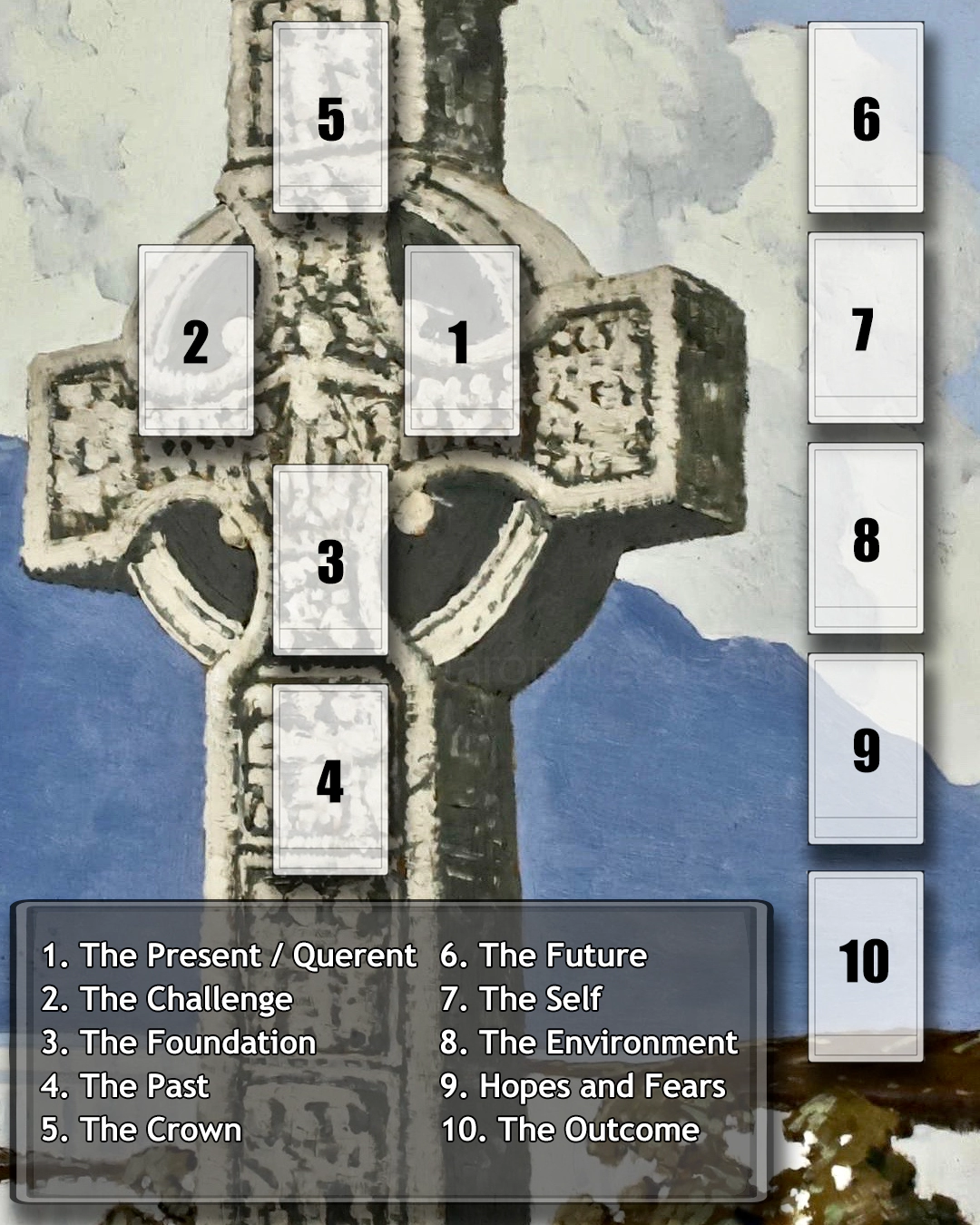
Alternative Stacked View (The Cross and The Staff)
| The Central Cross (Internal Dynamics) | The Staff (External Path) |
| Position 5: The Crown (Conscious Mind) | Position 10: The Outcome |
| Position 1 & 2: The Present & The Challenge | Position 9: Hopes & Fears |
| Position 3: The Foundation (Subconscious) | Position 8: The Environment |
| Position 4: The Past (Passing Influence) | Position 7: The Self |
| Position 6: The Future (Immediate Action) |
The 10 Position Meanings
Reading the Celtic Cross requires you to look at each card individually, and then understand how it converses with the rest of the layout. Here is a comprehensive breakdown of all ten positions to guide your interpretation.
Position 1: The Present / The Querent
This card represents the heart of the matter. It anchors the entire reading, showing you exactly where the querent stands at this very moment. It reflects your current state of mind, your core energy, or the primary theme of the situation you are inquiring about.
- Practical Example: If you pull a Major Arcana card here, like The Fool, it indicates that you are at the absolute beginning of a new journey, carrying a sense of naive optimism. The entire reading will be colored by this need for a leap of faith.
- Questions for the Querent: What is the core truth of my situation right now? What energy am I bringing to this reading?
Position 2: The Challenge / The Crossing
Traditionally placed horizontally across Card 1, this card represents the immediate obstacle or opposing force. It is the friction in your current situation. Importantly, this card is rarely “bad”-it simply identifies what you must overcome or integrate to move forward.
- Practical Example: If you pull a card from the suit of Swords, such as the Eight of Swords, your challenge is mental entrapment. The obstacle isn’t physical; it is your own limiting beliefs crossing your path.
- Questions for the Querent: What is blocking my progress? Is this an external force, or am I getting in my own way?
Position 3: The Foundation / The Subconscious
Positioned beneath the central cross, this card reveals the root cause of the situation. It highlights the subconscious influences, hidden drives, or deeply embedded past experiences that have built the foundation for your current reality.
- Practical Example: Pulling the Six of Cups here suggests that childhood memories, nostalgia, or an unresolved issue from your deep past is the unconscious driver behind your current question.
- Questions for the Querent: What underlying beliefs have created this situation? What am I not acknowledging consciously?
Position 4: The Past / Passing Influence
Situated to the left or bottom of the cross, this card represents recent events that have led directly to the present moment. Unlike the Foundation (which is deeply rooted), this is a passing influence-an energy that you are actively leaving behind.
- Practical Example: If the Ten of Wands appears here, you are emerging from a period of intense burnout and heavy burdens. The worst of the exhaustion is in the past, but its lingering effects still touch your present.
- Questions for the Querent: What recent events have shaped my current reality? What baggage is it time to put down?
Position 5: The Crown / Conscious Thoughts
Placed at the top of the cross, the Crown represents what is on your mind. It shows your conscious goals, your ideals, and what you believe is the best possible outcome. It illuminates your direct focus and your conscious awareness of the issue.
- Practical Example: Drawing a Pentacles card, like the Three of Pentacles, means your conscious mind is heavily focused on collaboration, mastery, and building a secure material foundation.
- Questions for the Querent: What is my highest aspiration in this matter? What am I actively focusing my energy on?
Position 6: The Future / Immediate Trajectory
This card reveals what is coming next. It is the immediate future-usually within the next few weeks or months. It shows the natural next step that will unfold based on the current energies of the Cross.
- Practical Example: The Knight of Swords in this position warns of rapid, perhaps impulsive, communication or action approaching. You will need to brace for a sudden shift in momentum.
- Questions for the Querent: What is the next immediate step unfolding before me? How can I prepare for this incoming energy?
Position 7: The Self / Internal Attitude
Beginning the upward journey of the Staff, Card 7 acts as a mirror. It represents how you view yourself within this situation. It highlights your internal attitude, your confidence levels, and your personal approach to the challenge at hand.
- Practical Example: If you find The Hermit here, you view yourself as an isolated seeker. You might feel alone in your struggle, prioritizing deep introspection over asking for external help.
- Questions for the Querent: How is my self-perception influencing this situation? Am I giving away my power or standing in it?
Position 8: The Environment / External Forces
This position outlines the external factors surrounding you. It represents family, friends, work environments, or societal expectations. It shows how others perceive you and the energies that are outside of your direct control.
- Practical Example: Court Cards often appear here. If the Queen of Wands lands in Position 8, an influential, fiery, and supportive person in your life is heavily impacting your situation.
- Questions for the Querent: Who or what is shaping my reality from the outside? Is my environment supporting my growth or hindering it?
Position 9: Hopes & Fears / Inner Desires
Often considered one of the most revealing cards in the spread, Position 9 uncovers your secret anxieties and your deepest desires. Because hopes and fears are intimately connected (we fear losing what we hope to gain), this card requires careful psychological reflection.
- Practical Example: Pulling the Nine of Swords indicates pure anxiety keeping you up at night; your fear of failure is currently overpowering your hope for success. Conversely, The Star here shows profound hope and spiritual healing guiding you.
- Questions for the Querent: What am I secretly afraid of? Are my fears entirely in my head, or are they grounded in reality?
Position 10: The Outcome / Final Resolution
The pinnacle of the Staff represents the ultimate outcome. This is where the situation is heading if you stay on your current path. Remember, tarot is not a strict decree of fate; if you do not like the outcome shown in Card 10, you have the agency to change the energies identified in the previous nine cards.
- Practical Example: If The Tower appears as the outcome, it warns that the current structure of your situation is unsustainable and is headed for sudden collapse. You can use this knowledge to dismantle it safely yourself, rather than waiting for the fall.
- Questions for the Querent: Where is this path leading me? Am I satisfied with this destination, or do I need to change my present actions?
Reading Tips for Celtic Cross Tarot Spread
In my experience, the biggest mistake beginners make is reading the Celtic Cross as a simple list of ten isolated messages. The true magic happens when you understand the card dynamics-how the cards actually talk to each other across the table.
I always recommend looking at Cards 1 and 2 together before you do anything else. This is your central conflict. The crossing card isn’t just a static obstacle; it is the necessary friction required for your personal growth. If Card 1 is highly passive, like The High Priestess, and Card 2 is intensely active, like the Eight of Wands, your core tension is the struggle between trusting your intuition and the pressure to act urgently.
Next, examine the temporal flow of Cards 3, 4, 5, and 6. This makes up the timeline of the cross. Notice how the deeply buried subconscious roots in Card 3 push upward to influence the conscious thoughts of Card 5. Ask yourself: are they aligned, or are your hidden beliefs secretly sabotaging your conscious goals? Meanwhile, the passing influence of the Past (Card 4) gives way to the immediate trajectory of the Future (Card 6).
Then, follow the upward path to the outcome through the Staff (Cards 7 to 10). This vertical column shows how your internal attitude (Card 7) and external environment (Card 8) feed directly into your deepest anxieties (Card 9), ultimately manifesting the final resolution (Card 10). If the outcome appears negative or challenging, I look straight back to Card 7: usually, shifting your internal attitude alters the entire trajectory of the spread. If your Staff consists entirely of Major Arcana cards, the path to the outcome is driven by major karmic shifts rather than everyday, mundane actions.
Finally, reading reversed cards in this specific layout requires nuance. A reversed card in the Foundation (Position 3) often points to deeply repressed emotional trauma, while a reversal in the Environment (Position 8) strongly suggests chaotic, manipulative, or unreliable external forces that you cannot easily control.
Common Variations of the Spread
While the standard 10-card layout is incredibly powerful, tarot is a living, breathing practice. Over the years, readers have adapted the structure to better fit their intuitive flow. Understanding these common variations of the spread can help you customize your readings to fit the exact nature of your inquiry.
- Traditional Variation: In the classic Waite-Smith method, Card 2 is placed horizontally directly across Card 1, visually locking the central conflict and immediate obstacle together in a cross.
- Modified Variation: Some modern readers prefer placing Card 5 (The Crown) floating directly above the cross rather than integrating it into the center. This highlights your conscious thoughts as an overarching umbrella rather than a direct timeline step.
- Expanded Tarot Variation: For highly complex life questions, readers often pull additional clarifier cards around key positions. For example, if the Outcome (Card 10) is a cryptic Major Arcana card, pulling a three-card clarifier spread alongside it can ground that overarching archetype into actionable, everyday advice.
Continuing Your Tarot Journey
Mastering this 10-card layout takes time, patience, and a willingness to explore the intricate relationships between the major and minor arcana. Once you feel comfortable going through the deep subconscious influences and temporal flows of the Celtic Cross, you should explore other structural layouts to expand your divination. To discover more ways to pull the cards and answer complex life questions, return to our complete directory of beginner and advanced Tarot Spreads. From simple three-card daily reflections to complex astrological wheels, practicing different layouts will continually sharpen your intuition and elevate your reading skills.